Address
Kaypian, San Jose Del Monte City, Bulacan Philippines
Work Hours
Monday to Friday: 8AM - 6PM
Weekend: 10AM - 5PM
Address
Kaypian, San Jose Del Monte City, Bulacan Philippines
Work Hours
Monday to Friday: 8AM - 6PM
Weekend: 10AM - 5PM

Integrated HR. Accurate Payroll.
Integrated HR. Accurate Payroll.
 Byadmin
In today’s fast-evolving workplace, HR teams are under constant pressure to do more — manage people, ensure compliance, track performance, and deliver exceptional employee experiences. Doing all that manually isn’t just inefficient — it’s unsustainable.
That’s where the Human Resource Information System (HRIS) comes in.
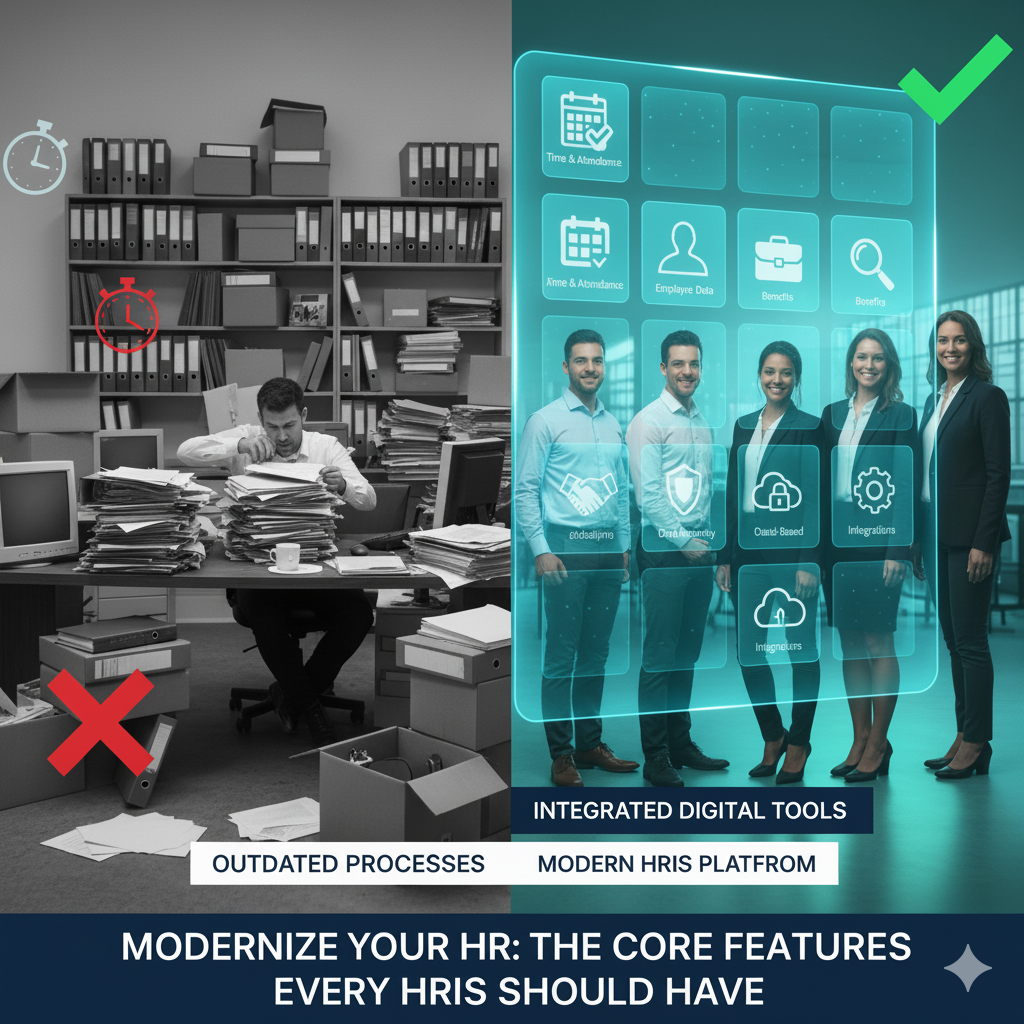
An HRIS centralizes and automates HR functions, transforming traditional HR operations into a seamless, data-driven system. But not all HRIS platforms are created equal — choosing the right one means understanding the core features that truly matter for modern business success.
A Human Resource Information System (HRIS) is an integrated digital solution that helps organizations manage and automate various HR processes — from recruitment and payroll to performance and analytics.
At its core, an HRIS acts as a centralized database for employee information, ensuring accuracy, efficiency, and compliance while freeing HR professionals to focus on strategy rather than paperwork.
Here are the essential features your HRIS must include to keep your organization competitive, compliant, and connected:
Every HRIS starts with a secure, centralized database for all employee records — personal details, employment history, certifications, and more.
An efficient HRIS automates salary calculations, deductions, bonuses, and tax compliance.
Accurate attendance data is essential for payroll accuracy and workforce planning.
Modern HRIS systems simplify hiring and new-hire integration.
✅ Streamlines job posting and applicant tracking
✅ Automates onboarding checklists and digital document signing
✅ Enhances candidate experience from day one
This feature helps organizations evaluate, motivate, and develop their people.
✅ Enables goal-setting and performance reviews
✅ Tracks KPIs and competencies
✅ Supports 360-degree feedback and development plans
Continuous learning is vital in the digital era.
✅ Provides access to training modules and certifications
✅ Tracks employee progress and completion rates
✅ Aligns learning programs with company goals
A modern HRIS empowers employees to manage their own data.
✅ Lets employees update personal info, view payslips, and file leaves
✅ Reduces HR workload
✅ Promotes transparency and engagement
Data-driven decision-making is no longer optional.
✅ Generates real-time HR dashboards
✅ Tracks metrics like turnover, headcount, and costs
✅ Helps leadership make strategic, evidence-based decisions
Data protection is critical for building trust and avoiding legal risks.
✅ Role-based access control and encryption
✅ GDPR, HIPAA, and local data privacy compliance
✅ Automated audit trails and secure cloud backup
Today’s workforce is mobile — your HRIS should be too.
✅ Accessible on smartphones and tablets
✅ Ideal for remote or hybrid teams
✅ Improves flexibility and engagement
By adopting an HRIS with these essential features, organizations can:
A well-implemented HRIS doesn’t just streamline processes — it elevates HR into a strategic business partner.
When evaluating HRIS platforms, look for one that:
✅ Scales with your business growth
✅ Offers integrations with your existing tools (e.g., payroll, accounting, CRM)
✅ Provides customizable modules
✅ Ensures strong data protection and user-friendly design
Remember: the best HRIS isn’t the most expensive — it’s the one that best fits your organization’s needs and future goals.
The modern workplace demands speed, accuracy, and innovation — and your HR department should be no exception.
By adopting a feature-rich HRIS, you empower your HR team to focus on people, not paperwork. With automation, analytics, and secure digital tools, HR leaders can drive efficiency, employee satisfaction, and long-term business success.
If your HR processes are still manual, it’s time to modernize. The future of HR is digital — and the right HRIS is your first step forward.